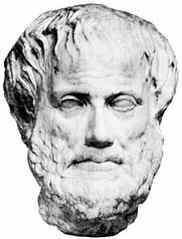
He lived a long time ago, and as those in my Philo class know, it is not easy to "translate" him into modern ethical dilemmas. We want answers, what to do in situation x or in case y. But the big A is not always interested in this. So the question is (literally, for my students doing their essay this weekend) does Aristotle give a sufficient "action-guiding" approach to ethics? Or, as one student put it, is it simply a focus on how to become "virtuous" but that what "virtuous" means will vary from person to person? If so, this would be a form of moral relativism. But scholars of Aristotle resist that charge. They say that he does define virtue, and that while he gives no rule like the "categorical imperative" of Kant to apply in every case, Aristotle does provide an approach to making all of our decisions. So let's get into this here for a moment, so we all can shed some more light on the questions.
Some key quotes (on pg. 414-415) show that Aristotle admits that "scientific exactitude is impossible in treating particular ethical cases." Do you agree? A also says that if we use "right reason" we can achieve "a sketch" of what good conduct looks like. So in the particular cases that people face everyday, like....
-should we stop the feeding tube for our comatose and elderly mother?
-how much alcohol should I drink, if at all?
-how much money should I keep in the bank and how much give away?
-should my partner and I have sex?
-will I be honest with a friend who needs to be challenged?
...one has to use reasoning to show one course of action is better. And how do we judge "better." Well, by which action is more in accord with the virtues. We start asking questions about how this or that virtue would be present in a course of action. It may not be math or offer a quick answer, but it would sure frame the right questions to ask ourselves.
Now, the Big Point of Aristotle is that the only way to really have wisdom (phronesis) on these matters is through formation and training (askesis) in good habits. This is why for A education is so key: people have to be trained to recognize the true, the good, the beautiful. Part of this is objective (a sunflower just IS more beautiful than a weed) but without training, A said, a person (or even a culture!) can get warped into confusing what is false for what is true.
The next biggest point of Aristotle is that the life of virtue and arete (excellence) is necessary for true eudaimonia (happiness, human flourishing). So here too we have some help in deciding how to handle particular cases. Act in such a way that we flourish and are happy. Now, the text gives many quotes as to how this is not some superficial happiness, but deep and profound happiness. So what the Big A is doing here is (in my view) brilliantly getting us to include deep happiness in discussions about mundane, everyday choices. It makes us take the long view, not just looking at "what works" or "what feels good" or "what must be done." Rather, what actions will help us realize our true end (telos) as human beings. That, says A, is what it's all about.
One last point: we still have to look at the question of pluralism. Different cultures have different accounts of virtue, even different accoutns of what it means to be happy. Let me share a story:
Each year on the Ghana trip we get to know the Holy Cross Bros. Well. last year one of them had just returned from a trip to a funeral in the northern region of Ghana. He told me he had traveled there with his mom. I asked, "who died?" "My father's wife," he responded. Uh, what? "Oh yes, Mike Kofi (my name there), my father had three wives, and it is a sign of respect and virtue that when a wife dies the others attend."
Okay, so very different notion of virtue here. Does that mean that virtue is relative? Well yes and no. What it mostly means is that particular practices (we could compile a long list, involving behavior in the area of sexuality, money, food, religion, friendship, killing, work...) take their meaning from a cultural context.
Perhaps it looks like this:
-Some principles seem to be basically objective and universal (respect for elders, aid to the poor, dignity of marriage, care for children).
-The practices that apply those principles vary, according to the moral traditions in the community of which one is a part.
-The virtues that result from being trained in those practices thus also vary some, according to the community.
-Whether an action is "moral" depends on how it relates to all of these: the universal principles, the community's practices, the shared notion of virtue.
Thus, for Virtue Ethics, a lot depends on the community. What is going on now is that the notion of "community" and "tradition" have broken down, and people are left to wonder: "Is there such a thing as 'right' and 'wrong'?" Since there is no scientific, objective agreement "out there", they say "No, morality is all just a matter of opinion."
But they say this because we have largely lost one of the above mentioned three pillars of Virtue Ethics: the moral tradition of a community. Maybe this is why some say Aristotle is not "objective" enough and that all he can give is "a sketch." I mean, he WAS part of a community that had traditions and practices; there was a consensus about what virtue was, or at least a common set of terms to debate it. Now, we lack that; everyone has different assumptions. We mainly try to "go it alone" in ethics.
And this, in my view, is why deontology and (esp) utilitarianism are so popular. They give ME a way to figure things out. But what gets lost in this is a shared sense of virtue and happiness that I simply cannot find alone. To find such meaning, at least according to Aristotle, we need communitty and tradition. It is a kind of midpoint, a "Golden Mean" if you will, between individualism on one hand and total world-agreement on the other. Okay, so those are some thoughts that I hope help frame the discussion.


5 comments:
Aristotle gives us a lot of vague guidelines to follow to find the 'right' action. The world around us is a full spectrum of gray and with each action/choice there are many times more than just a "yes or no", "black or white" or an "X-Y" situation. It isn't that simple in any instance and in many cases there is a full alphabet of variables that needed to be accounted for. This is why A does not give us a universal law or set way to do things like Deontology or Utilitarianism.
A's virtue ethics, in my eyes, is a lot like Christianity. Just like there are 10 commandments to give us a guidance on how to life a righteous life, A gives us the virtues. Without the bible and tradition, the 10 commandments alone would not suffice for everyday choice making just as without experience and culture, the virtues would be useless. Just like Christianity, there is a lot that each individual has to figure out on their own through their own reasoning on to which is right and just.
In the example of the fat man in the cave, A would likely say that there is no virtuous actions in killing the fat man, only selfishness and that the people would die with high honor. However, on the other hand, if the fat man was a virtuous person, he would choose to extinguish his own life out of selflessness and let the others survive as his death would be in high honor.
-Chambers
Now THAT is an example of a fine post, Mr. Chambers. A good first post for the class. Not all have to be that length, but great insight. Your pt that "Without the [rest of the] bible and tradition, the 10 commandments alone would not suffice for everyday choice making just as without experience and culture, the virtues would be useless." Yes!
I am a big fan of Aristotle's virtue ethics because of the subjective view among the different situations. I am also a fan of the combination of a subjective path to get to the objective end that is eudemonia. Lastly, I like the consistency that virtue ethics has. We always default to what is virtuous at the time, which can vary among situations, but is based on the virtues of the person. For me, decisions I have made and will make are based on reasons that are reoccurring. This connects in many ways to Aristotle.
First of all I find these facts outdated considering they were published over eight years ago. Also, eight years ago there was not this type of techonolgy used. Assignments are much easier to get done with the use of high tech commputers, calculators and other gadgets. Therefore I find it much easier for people still to drink heavily and be far more successful than they could have been then. I really do not see a problem with people drinking even when they become intoxicated. I feel that as long as drinking does not effect a student's work, there is nothing wrong with it.
Let binge drinkers face their own consequences and let those who are bothered by them go to the library, it is not like a drunken student is gonna follow you wherever you go when you wanna study. For those who where "insulted or humiliated" and then reported it on a survey deserve to be insulted, let them cry to their moms not to me.I am saddened that drinking in colleges is this big of an issue, if you compared the colleges that have a dry campus and those that dont, grades are usually the same, people are usually the same, the only thing that makes them all different is that the students on the dry campus will tell you about their creative way of hiding their alcohol
Post a Comment